Kalmar Union 2.0: Why this Nordic alliance needs to be expanded post brexit

Denmark, Finland, Iceland, Norway and Sweden

Five nations with a common history and culture in which at one point were in a union called the Kalmar Union. What if this union existed again today? What would it look like?

A union of 27 million people with a GDP of 1.54 trillion dollars.

If the Kalmar Union was a country, the population and GDP would be larger than Australia and be the seventh largest country by land mass in the World. Also, all of these countries in one way or another have implemented the Nordic Model which is one of the most scrutinized, praised and studied set of social and economic policies today.

In a current World where nationalism, populism and growing skepticism of the European Union is present; the idea of new unions similar to EU but smaller in size and tighter in social and political cohesion is very feasible.

The EU is a continental-sized experiment in hope of creating a peaceful Europe and World while building a union comparable to the economic and diplomatic power of the United States. However, that is easier said than done.

Think of Europe as one big confusing, conflicting family with a long history of warring with each other for power and dominance. Meanwhile this same European family with different cultural, political, linguistic and economic histories is trying to get on the same page thus create a “United States of Europe”. Yeah, that was a daunting task from the beginning.

In my opinion, the EU should break up and be an alliance of regional continental states and/or unions. For example, the Nordic Kalmar Union working with a German/Austrian alliance or an Iberian alliance or a Benelux Union. Even in this world, the Swiss can still be neutral.
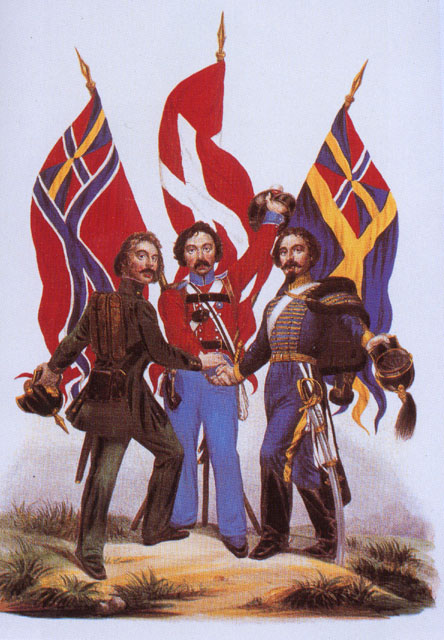
Skandinavism

A poster from the 19th century promoting unity of Scandinavia. (Source: Wikipedia)

  • Brief History of the Kalmar Union

A union between Norway, Sweden and Denmark did exist at one point during the 1400s when they all were under one monarch and these nations felt the union was needed to thwart a growing power in Germany at the time. Unfortunately differing individual interest among the nations led to a complete division by 1905.

A modern co-operation called the Nordic Council was formed after World War II and created an economic customs union and passport-free travel between the Nordic countries in the 1950s. Fast forward to now, the Nordic Council develops policy on different topics like energy and education for the Scandinavian region.

However, a modern Kalmar Union led by a unilateral consensus of the leaders of all the Nordic nations developing a respectable and/or protective alliance to counterbalance a degradation of the EU is not as straight forward as it seems. However, the current landscape yields to an optimistic perspective of such a task being taken by leaders of the north.

  • Why a Union of Unions might be better than the EU

If anybody is a student of European history, they will know that the continent is a land mass with a plethora of cultures, languages, religions with the seemingly keen interest with fighting each other. Luckily there has been “relative peace” since the Balkan Wars but there is still the tricky reality of the differences between northern, southern, western and eastern Europe.

Skulptur Britt Smelvær

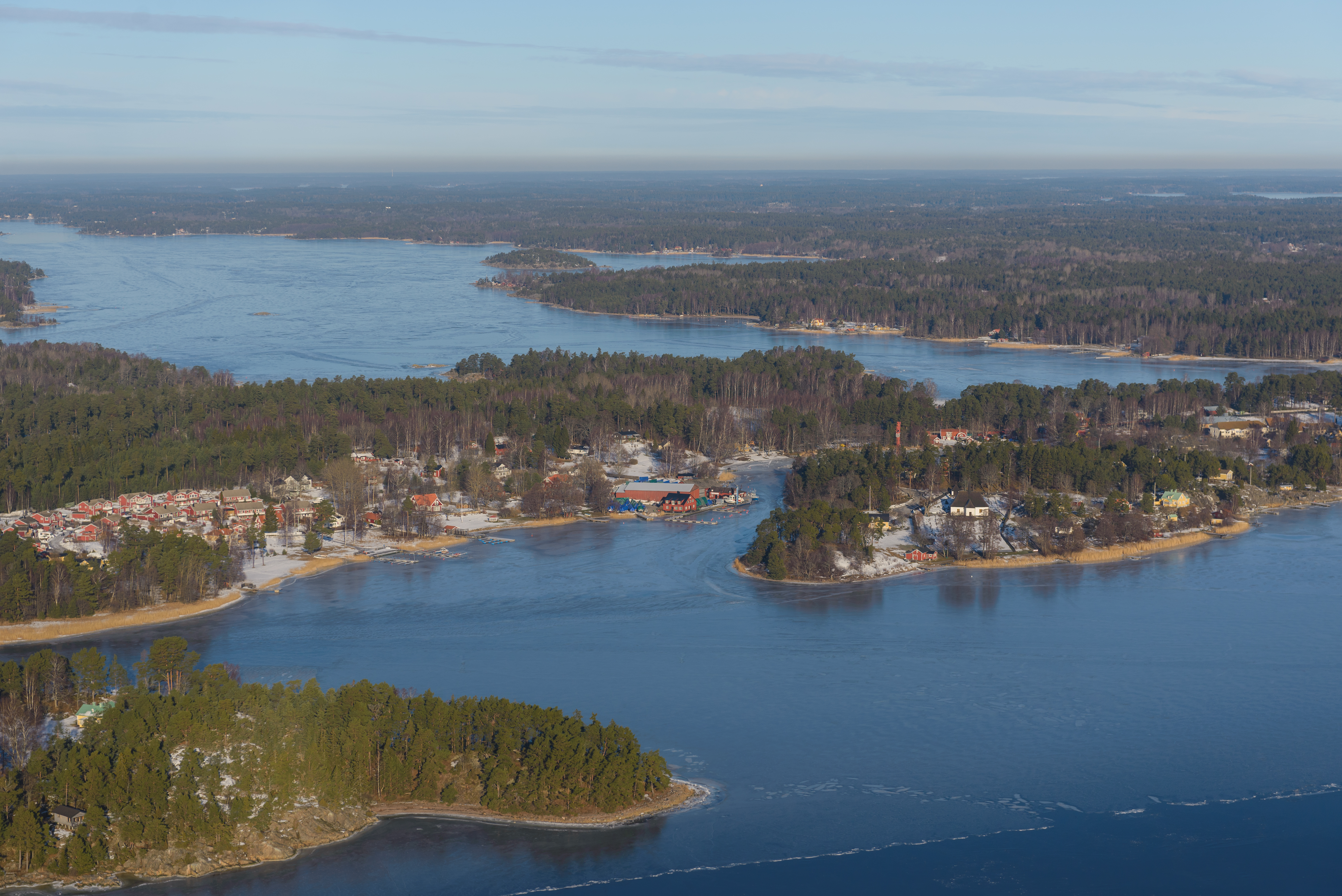
The beautiful “Land of the Vikings”. (Source: The Nordic Council)

  • How would it work?

To put it simply, a Nordic “EU” in most form and functionality. If you look at the current setup of the Nordic Council, you have part of the structure already in place. The Nordic Union has its own Council of Ministers (equivalent of the European Council) and general Council (Nordic European Parliament).

In my opinion, only some expansion to the current Nordic Council is needed. You need a Nordic version of the Council of the European Union to formulate a bicameral legislature. The foundation of a Nordic Supreme Court to harmonize the different national courts. Moreover, an executive branch of political and governmental leaders like the European Council and European Commission is required as well.

However, I think a central bank or currency will be the main difference between the EU and my idea of a “beefed up” Nordic Council. A basic currency agreement will create a standard and regulated exchange rate between all 5 national currencies while avoiding a similar controversy like the Euro.

  • Conclusion

Is this idea a far-fetched dream crafted in the mold of modern “Scandinavism” that is bound to not happen or fail if attempted?

Maybe.

I gave a loose layout of a Nordic mini-EU, yet with the concerning trends I mentioned bubbling up across the continent and around the world, the idea is not that far from the realm of reality and possibility. Recently a poll showed preference to a “Nordic Union” compared to the EU. Yes, Scandinavians are open to the thought of a new Kalmar Union. And yes, I agree with their sentiments. This would most certainly open up the conversation of the audacity of the north going out on their own.

The Expat Life: The Evolving Identity

In a few months I will have lived abroad for 6 years. 5 countries and 4 continents later, lets just say my perspective of myself and the world has drastically changed.

If you compared me in 2012 before my expat journey to me now going into my third year in Sydney, you will see a significant difference.

I believe, I have grown exponentially. I have experienced success, failure and some mediocrity or unwanted complacency of ambitions yet to be fulfilled. Through all of this, I have developed grit with a much nuanced view of the world. I am not saying I had a naive or narrow-minded view of the world before, but my view of world naturally changed after getting the chance to actually seeing it.

Like most expats, you inevitably change. Main change is how you see yourself or your self-identity.

Lupe Fiasco rhymed in his song “Gold Watch“:

I am American mentally/with Japanese tendencies/Parisian sensibilities…

That got me to thinking. How would I describe myself? Well, I came up with the below.

I am African-american mentally with British tendencies and slight Swedish sensibilities.

Not as smooth as Lupe, but I will run with it for now.

My wife Sanna refuses to allow any Norwegian influence on me as she sees that as some form of corruption. Meanwhile, it remains to be seen how much of the Aussie experience will leave a mark on me.

I am an intelligent black man (“Mr. IBM” as my mother would call me growing up and still does to this day) and that will forever be at the base of my identity and I take pride in that. Beyond that foundation is my complicated identity as an American.

Being an American of African decent, my relationship with the United States is not simple by any means. As far as I can tell, I am the fifth generation of freed slaves and along with my sister, we are the first beyond our parents to live in a “post segregation” America. Yet, America is not “post racial”. Not by a long shot. Furthermore, America has taken a Trumpian turn for the worse as American society.

I can go on but for the sake of brevity, let’s just leave it at the fact that my relationship with America has a lot to unpack.

Swiftly moving on.

I’ve had the opportunity to live in the United Kingdom for three years. During those three years, I have garnered some forms of Britishness.

Where do I start? I appreciate quirky and dry British humor and wit. Nothing like going for a pint after work (especially on Fridays). I slightly cringe when I do see a proper queue to get on a bus or train. I have said it before, but I do love a good Chippy (fish and chips shop), kebab, curry, and fry up (full English breakfast). In addition, I have become a slight tea snob (Twinings for the win).

I have lived longer in Sydney than in London. Yet, I still see myself as Londoner to this day but not a Sydneysider at this point in time. Let that marinate for a second.

I have lived with Sanna for almost five years now. Additionally, I have visited Sweden and my in-laws on numerous occasions. Because of that, I have and continue to be under the heavy influence of Swedish (and general Scandinavian) culture and thinking. You can’t help but learn a thing or two from the Nordics.

America is the most individualistic nation in the world. That is a double-edged sword that cuts deep into the prevalent successes and failures of the American “Way” or “Exceptionalism”.

Meanwhile, Sweden is more collective as a society. Some people will call them the dreaded word socialist. However, because of this collective or socialist thinking, they are some of the best countries to live in. Maternity (and paternity) leave, universal healthcare, free education (even at the university level) and a very progressive environmental policy. That is just some of the good stuff Sweden is doing and their policies have influenced my political thinking a lot more than the Brits.

Don’t get me wrong, Sweden is not a perfect place. Check out the issues of immigration, integration and xenophobia/racism. But like an à la carte menu, I pick and choose political ideas that seems to make logical sense that is best for humanity from the places I have lived or at least observed.

Wow. I didn’t expect to go that deep into political and societal commentary. Sorry for going down the rabbit hole on that one.

Back to Sweden. I love the Swedish food. They make good bread. Their crisp bread (knäckebröd in Swedish) is diverse as pasta is in Italy. Plus, they take pride in making quality food products due to their high food standards (I am looking at you US Food and Drug Administration). Because of the dark winters, Swedes love having candles throughout the house. I look up from my computer screen now and see two big candles within view. And Sweden and Scandinavia for that matter has some of the most beautiful slices of nature from the mountains to the coast and islands a person can see.

I can go on but I want to go another point. After living abroad, my bias to products and brands has changed. I was predominantly American in this area. However, my personal list of favorite products has expanded and diversified.

I write this because, naturally the brands you are loyal to also speaks of your identity.

Going back the song “Gold Watch” by Lupe, he says:

I like Diptyque candles and Maharishi sandals and
Dita sunglasses, Purple Murder Service samples
I like False T-shirts Dover Street is off the handle
Such a good designer, Junya Watanabe, god damn you
I like Yohji Yamamoto and a Max Roach solo
Leather Gucci belts and Guilty Brotherhood polos
I like Montblanc pens and Moleskine paper
I like Goyard bags and green Now and Laters
Monocle magazine and Japanese manga
Futura Nosferatus and HTM trainers
I love Street Fighter 2, I just really hate Zangief
Only Ken and Ryu, I find it hard to beat Blanka
Keep a Wee Ninja hanging and an UNKLE album banging..

Don’t get it twisted, I am not over materialistic. At least I don’t think I am. Actually, living abroad and moving around quite a bit has forced to me stay lean with items and only travel with the essentials. So I want to make that clear.

I do have a list of prized possessions or brands/products I trust and are go to items. I love a good Moleskine note with a quality pen. I have a Barbour bag and Fjällräven backpack plus a Samsonite weekend bag that swear by. I am still a PlayStation gamer and represent team Nike/Jordan.

I can’t go wrong with Clark shoes, or Dressmann underwear. Yes, I have become particular about my under garments. M&S cashmere jumpers (or sweaters as we call them back home in the US) and Mason Cash or Le Cruset kitchenware comes to mind as quality products I always go for if possible.

I am not name dropping to show off. More times than not, I am okay with a cheaper brand/product as longs as it actually does the job intended. But, there are just some things I just can’t go without.

I usually try to have a Moleskine near me to write any notes that I want to save.

Good or bad, based on what I mentioned above, you have formed an initial or modified an existing view of me. Yet, that’s the point. Fair or not, what I consume is an important part of my identity.

Let’s just say as cliche as it sounds, I have grown. Yes, I would have grown if I have stayed in the US and only have traveled abroad from time to time. On the contrary I think a 32 year old Michael who did’t leave for Europe almost six years ago would look very very different to the Michael you see now.

I foresee at least another 5 years or so outside the United States and this is definitely by choice. I do miss the day-to-day opportunities to spend time with my friends and family. But I don’t miss living in America and everything with comes with it. As of now, I am content with going home a couple times a year but quickly head back out when I am tired of the craziness that is Planet America*.

* I give credit of that name to the amazing US political commentary show here in Australia.


Introduction: My Swedish

Hej! Jag heter Michael Byrd och frå Florida men jag bor en Sydney med mi fru Sanna. Mi Svensk är ingen bra men jag behöv til prata och läser mer nu.

My Swedish is not the greatest, however I do take pride at how much I have learned and the majority of that knowledge was amassed from observations, awkward conversations with my in-laws, poor self-learning, Swedish television and movies with my desire to learn how to curse in a different language.

I am not just learning Swedish the language, I am immersing myself in the culture of my wife’s homeland. Sweden is an interesting nation with an equally interesting history.

I have learned early that, “the best way to learn is to teach” and I will continue learn more about the language and culture of Sverige (Sweden) and I will love to share my observations and experiences.

Tack så mycket! (Thank you so much!)